
As part of USP College’s EPAS spring term program, the EPAS groups in Seevic and Palmer’s campus ran a variety of citizenship projects. This Seevic-based group focused on the issue of housing and what students think about housing solutions. This included the following EPAS ambassadors: Ana Sahajahan, Hollie Perry, Lilly Nunn, Macy Rimmell, Niamh Thurston, Rose Sparks and Sebastian Rapley Mende.
Report:
The main aim for our citizenship project was to spread awareness on the topic of housing and how young people today face a variety of issues with housing affordability. Throughout this project we were trying to understand how much information individuals know about the different types of housing available and affordability whilst also incorporating their feelings on the current state of the housing market.
As a group, we chose the topic of youth housing because we believed that housing is a national concern that is often overlooked, and we believed there was little awareness of how big of a problem it is becoming. Housing costs have risen significantly over recent years and are continuing to increase, making it harder for young people to rent or buy homes. The housing market also has made it difficult to rent and then move on to purchasing a house due to the disparity between average wages and average house prices. Researching the issue of youth housing also allowed us to explore how economic factors, government policies and social inequality impacts the opportunities available to young people. We decided that we would look at student’s views from across the college and find out if there was a real concern about housing in their area.
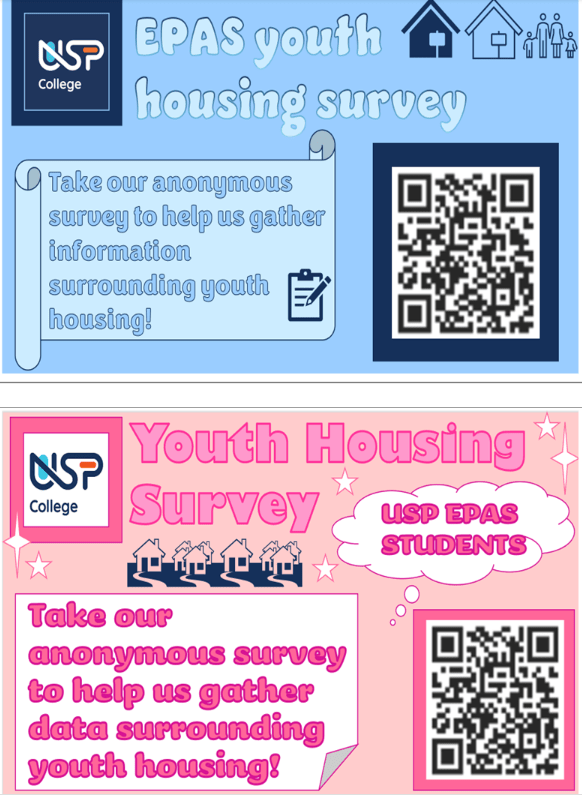
We created an online survey containing questions which would help us gain an insight into statistics and opinions within the issue youth housing (see: ‘Survey Results & Analysis’ section, below). To promote our survey, we created posters and leaflets to display around USP college in order to improve engagement and ensure a wide range of results. This was done to make sure the survey represented as many views as possible. After receiving the results, we were able to evaluate them which allowed us to form a better understanding of USP student’s / young people’s concerns and wants regarding the topic of housing.
When conducting our youth housing survey for the Citizenship Project, we met and overcame several obstacles to successfully retrieve the results we needed. Whilst collecting our data we had to combine our creative thinking skills and communication with our peers to get our aims across to young people at USP College. Another challenge we faced was engagement from students. To overcome this, members created appealing posters with access to our survey and promoted this around the campus as well as approaching students to encourage their participation. Small posters were displayed on tables throughout the college, from the canteen to the library, which allowed us to reach a broader range of students at the college.
Our EPAS group overcame this challenge as evidenced by the 41 students who engaged with the survey and communicated their feelings on housing. On average, each respondent spent 2 minutes and 56 seconds on the survey, demonstrating that students were taking the survey seriously, giving well thought out responses. Another challenge was creating direct and clear questions that students felt were answerable. This issue was overcome by making 14 out of the 15 questions multiple choice, with an optional written question at the end allowing students to specifically put down any thoughts they had. To make sure the survey was accessible, we created a QR code and trialed it several times before releasing it to the students on campus to ensure that everyone could access it without difficulty.
When constructing the survey, the group discussed potential questions for the survey to make sure the survey would retrieve the data needed but was also understandable to anyone – regardless of prior knowledge about housing issues – and suitable to their demographic, this being young people aged 16-18.
Reade the report’s findings and conclusions on the EPAS at USP College website: https://www.epasatuspcollege.co.uk/post/citizenship-project-students-housing-campaign
EPAS Team Comment
It is so impressive that you are identifying the issues you see as important and are taking action to raise their profile, and to research them.